
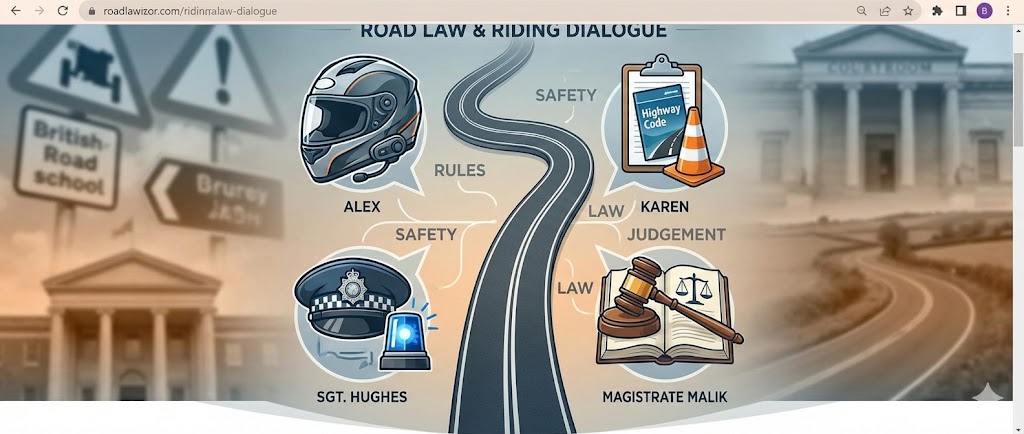
Preface (Opinion & Discussion Piece) This article is presented as an exploration of grey areas in UK road law and advanced motorcycle riding. It reflects a fictionalised conversation between an advanced rider, an instructor, a police motorcyclist and a magistrate. It aims to stimulate debate and support better understanding. It does not represent official policy from any organisation and is not legal advice. Riders should refer to the Highway Code, Road Traffic Act 1988 and TSRGD for authoritative guidance.
Using the Whole Road – An Expanded Four-Way Dialogue
Featuring: Alex (Advanced Rider) | Karen (IAM/RoSPA Instructor) | Sgt. Hughes (Police Motorcyclist) | Magistrate Malik (Traffic Court Magistrate)
Setting the Scene
Alex: Every time I ride with a new group, someone insists you can never cross a double white line. Then someone else says, “Actually no, you can cross them if the traffic is stationary.” Who’s right?
Karen: Both, depending on what they mean. People often repeat simplified versions of rules that don’t reflect the legal nuance.
Sgt. Hughes: And the nuance matters. This is one of the most misunderstood parts of the Highway Code.
Magistrate Malik: Which is why these debates keep happening — the law is written broadly, the exemptions are narrow, and interpretations vary.
What the Law Really Says (with Evidence)
Alex: Let’s start with the basics — what is the actual law?
Magistrate Malik: The offence is found in the Road Traffic Act 1988, s.36(1): “A person who fails to comply with the indication given by a traffic sign is guilty of an offence.” Solid white lines are traffic signs. The meaning of those lines comes from the Traffic Signs Regulations and General Directions (TSRGD) 2016, specifically Schedule 9 Part 7 para 3(2): “Where the line nearest to the driver is a continuous line, the driver must not cause any part of the vehicle to cross or straddle that line.”
Alex: “Any part of the vehicle” means mirrors too?
Magistrate Malik: Correct. The courts treat mirrors, panniers, crash bars — everything — as part of the vehicle.
Karen: That’s why the advice in advanced training is cautious: you can overtake on your own side of the line, but you must be absolutely sure no part crosses it.
What’s the Purpose of the Rule?
Sgt. Hughes: From the police perspective, the rule exists because of collision data. Crests. Bends. Poor sightlines. Double whites exist where misjudged overtakes kill people. Karen: But the rule often extends beyond the hazard itself, doesn’t it?
Sgt. Hughes: Yes — for practicality. If the danger area is 40 metres, the lines might cover 150 metres.
Alex: So sometimes they’re technically over-conservative?
Magistrate Malik: The engineering rationale is conservative by design. It must protect the average road user, not the best.
Passing a Stationary Vehicle — Singular or Plural?
Alex: Rule 129 says you can cross the line to pass “a stationary vehicle”. Singular. But a queue is multiple stationary vehicles. Is that allowed?
Karen: Riding groups argue endlessly about this.
Magistrate Malik: In statutory interpretation, the singular generally includes the plural, unless the context demands otherwise. So legally it could apply to more than one vehicle.
Alex: Then why does everyone say you can only pass a single obstruction?
Magistrate Malik: Because of the second part of the exemption: “If it is safe and without danger.” The problem with queues is that your view is partially or fully obstructed. Case analogue: A rider once contested a white line offence in magistrates’ court claiming the opposite lane was “empty”. The court held that “empty” cannot be assumed if sightlines are blocked by a queue. Conviction upheld.
Sgt. Hughes: That’s exactly how we see it. Passing one broken-down car is obviously different from filtering past 20 cars on a blind bend.
The Controversial Scenario — Opposing Traffic Held at Red Lights
Alex: What if I can see all the way to the red light? Opposing traffic cannot move. Technically, doesn’t that satisfy the “not dangerous” test?
Karen: That’s the scenario that makes examiners groan.
Magistrate Malik: In theory — yes. If the opposing lane is legally stopped and sightlines are fully clear, the prosecution may struggle to prove danger. But courts recognise behavioural unpredictability: lights changing, someone jumping the red, emergency vehicles pushing through, or vehicles encroaching the line. Risk isn’t zero. Case analogue: A rider was acquitted because the opposite lane was held at a long temporary red, and the manoeuvre occurred within a short distance of the stop line. Magistrates accepted it was not dangerous on that occasion. But emphasised this was an “unusual set of facts”.
Sgt. Hughes: That decision wouldn’t apply to most cases, though. Context is everything.
How Police Actually Charge These Offences
Alex: Do officers really charge people just for crossing the line?
Sgt. Hughes: Rarely. Technical offences alone aren’t the priority. Charges happen when your action forces someone to brake, creates confusion, causes another driver to react, or clearly increases risk. Potential charges include RTA s.36 (failing to comply), RTA s.3 (careless driving), RTA s.2 (dangerous driving), or Section 59 Police Reform Act (warnings for dangerous use). Crossing the line is the technical offence — but endangering someone is how it becomes a court case.
The Word “Necessary” — The Heart of All Debates
Alex: The word “necessary” appears in almost all the exemptions. What does it truly mean?
Magistrate Malik: In law: Necessary means you have no safe or reasonable alternative. It does not include saving time, making progress, improving road position, or avoiding inconvenience.
Karen: But in advanced riding, “necessary” includes improving visibility, reducing time alongside other vehicles, or positioning early. These are genuinely safety-based reasons.
Sgt. Hughes: And this is where riders get confused. The law must apply to everyone. Advanced riding assumes deliberate, trained judgement.
Hatched Areas — The Legal vs Practical Divide
Alex: What about hatched areas — another minefield. Karen: Broken borders = advisory. Solid borders = mandatory.
Magistrate Malik: Legally, Rule 130 says: “You should not enter an area marked with diagonal stripes unless it is necessary.”
Alex: Yet instructors often encourage using broken hatching for safety.
Karen: Because on a bike, metres of extra visibility can change everything.
Sgt. Hughes: And police rarely enforce broken hatching unless it causes an issue.
Why Law and Advanced Riding Often Appear to Conflict
Alex: So the root issue is that the law is designed one way and advanced riding another?
Magistrate Malik: The law must be predictable and cautious for the entire spectrum of road users.
Karen: Advanced training assumes structured thinking and hazard anticipation.
Sgt. Hughes: Two systems. Two purposes. Not always aligned — but both aim to reduce collisions.
Alex: Hence the endless debates.
Final Thought-Provokers for the Group
Karen: Should highly trained riders have more flexibility under the law?
Sgt. Hughes: If we write the law for the best riders, what about everyone else?
Malik: Should magistrates consider rider skill when judging “dangerous”?
Alex: And can the average driver even recognise when a manoeuvre is safe?